
Concrete Crack Injection in Egypt
ISC Group provides concrete crack injection in Egypt to treat leaking cracks, construction joints, voids, honeycombing and water ingress in reinforced concrete structures.
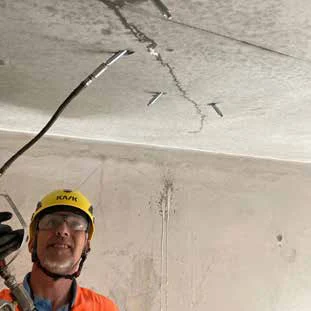
Specialist concrete injection in Egypt
Injection is a targeted repair process that introduces a selected resin or grout into cracks and internal voids. The correct material depends on whether the objective is stopping active water, sealing a flexible joint, filling a dry structural crack or consolidating weak and porous concrete. Our engineers review the defect, moisture condition, crack movement, access and service environment before confirming the method.
Injection applications
- Active leaks in basement walls and slabs
- Cracks in tanks and water-retaining structures
- Construction joints and wall-to-slab interfaces
- Honeycombing, voids and porous concrete
- Dry structural cracks requiring rigid bonding
- Tunnels, pits, lift shafts and underground structures
Resin and grout injection systems
Flexible polyurethane resins are commonly selected for water-stopping applications because they react or expand inside wet leakage paths. Epoxy injection may be specified for dry, stable structural cracks where rigid bonding is required. Cementitious or microfine grouts can be used for larger voids and selected geotechnical or masonry conditions. Every system must follow the approved technical data and consultant requirements.
Professional injection procedure
- Inspect and map the leakage or cracking pattern.
- Select resin, grout, pump pressure and packer spacing.
- Drill controlled holes and install mechanical or surface packers.
- Inject progressively while monitoring pressure and material travel.
- Remove packers, close holes and finish the repaired surface.
- Test the treated area and document completion.
Why injection work requires specialists
Uncontrolled pressure can widen cracks or send material into unwanted locations, while incorrect resin selection can produce only a temporary result. ISC Group uses trained technicians, maintained pumps and systematic injection sequences. We coordinate injection with waterproofing systems and concrete repair when defects require an integrated solution.
Quality control and project coordination
Before execution, the team confirms access, substrate condition, water pressure and nearby services. Trial areas can be used when conditions are uncertain. During injection, pressure, consumption and completed packer locations are monitored. After curing, treated areas are inspected for remaining leakage and reinstated using compatible repair materials.
Concrete injection services across Egypt
We support main contractors, consultants, developers and industrial clients in Cairo, the New Administrative Capital, New Alamein and projects across Egypt. See our project portfolio and specialist contracting services.
Basement leak repair and construction joints
Water visible at one crack may have travelled from another entry point. Before planning injection, we review the leakage pattern, nearby joints and the condition of the surrounding concrete. Treating a local leak can be one part of a wider basement waterproofing or concrete repair scope.
Information to send before a site assessment
Share photographs of the leaking area, the location and thickness of the affected element if known, and whether leakage changes with rainfall or water levels. Include previous repair details and access restrictions. The proposed injection sequence and material are confirmed after reviewing the actual defect.
Frequently asked questions
Can injection stop an active water leak?
Yes, when the leakage path is accessible and a suitable water-reactive resin and injection sequence are selected. A site inspection is required before confirming the solution.
Is epoxy used for every concrete crack?
No. Epoxy is generally suited to dry and stable cracks. Wet or moving cracks may require a flexible polyurethane system or another approved treatment.
Does injection replace waterproofing?
Not always. Injection treats defined leakage paths, while a complete waterproofing system may still be needed to protect the full structure.
For recognised repair principles, consult the American Concrete Institute.
Discuss your project with our technical team.
Share your project location, drawings, quantities and site photographs so we can review the requirements.